Election Integrity or Integrity Grift? The Myth-Making Machine Around Oregon’s Voter Rolls
Oregon’s voter data is publicly available and claims that it’s hidden are fiction. The real dispute was about processes and records, not access, but that truth gets buried under louder narratives.

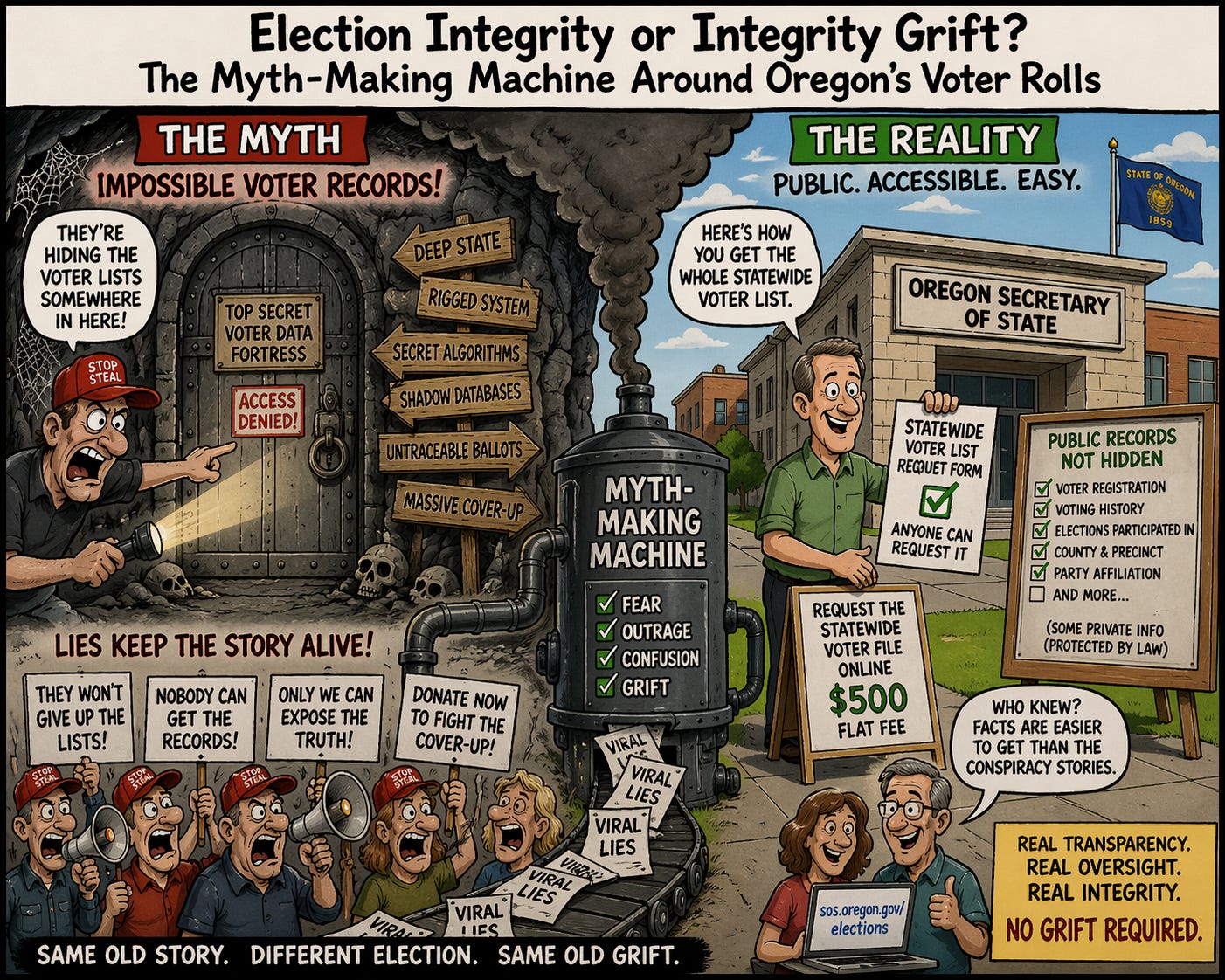
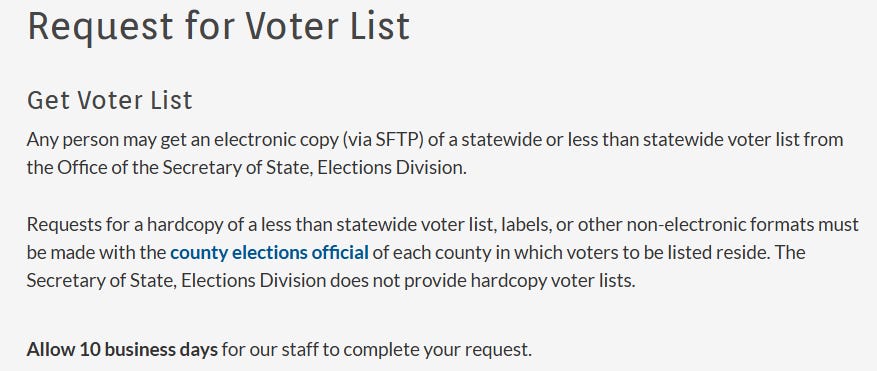
There is a certain breed of election commentator who loves to wrap himself in the flag, talk endlessly about “integrity,” and then immediately play fast and loose with the facts. Oregon’s voter rolls are one of the clearest examples. A myth keeps circulating online that Oregon “won’t give up the voter registration list,” as if the state is hiding the names in a vault next to the Ark of the Covenant. That claim is false on its face. Oregon’s Secretary of State publicly states that any person may request an electronic statewide voter list, and the statewide fee is $500. That is not a leak. That is not a whistleblower drop. That is a posted public process. (Oregon Secretary of State)
The confusion comes from people abusing the Judicial Watch lawsuit as a prop. The lawsuit was not simply, “Oregon refuses to release voter rolls.” In fact, the complaint itself undercuts that fairy tale. Judicial Watch and its co-plaintiffs said the Constitution Party of Oregon purchases and relies on Oregon’s voter rolls and does so because they are cheaper than commercial alternatives. So right there, in black and white, the plaintiffs acknowledged the voter rolls are obtainable and useful. What they were really suing over was whether Oregon was doing enough list maintenance under the National Voter Registration Act, and whether Oregon had produced the specific records about those maintenance practices that plaintiffs requested.
That distinction matters. A voter list tells you who is registered, their address, party registration, voter history, and similar allowed fields. A list-maintenance records request asks for something different: the state’s maintenance manuals, confirmation-notice records, audits, communications, change-of-address contracts, and data showing how the state keeps the rolls current. That is the difference between knowing your bank balance and auditing every deposit slip, transfer, fraud alert, and compliance memo behind it. Same bank. Different question.
The court’s August 2025 ruling makes this even clearer. Judge Michael McShane did not say Oregon’s voter list was off-limits. He allowed the core list-maintenance challenge to proceed for the Constitution Party of Oregon, while dismissing the separate records-disclosure claim without prejudice because the plaintiffs had not given proper notice before suing on that issue. In other words, the dispute over requested maintenance records ran into a procedural problem, not some grand judicial finding that Oregon’s voter data is untouchable. That online retelling is fiction with a keyboard.
And here is where the irony gets thick enough to spread on toast. The same people shouting that Oregon “won’t release the voter list” are often the ones claiming to defend election integrity. Yet Oregon law already draws a sensible line between public transparency and protected information. The state does release elector lists, but it also bars certain data from inclusion, including Social Security numbers and the birth month and birth day of electors, and it provides exemptions for protected residence addresses. That is not proof of corruption. That is what a functioning system looks like when it tries to balance transparency with privacy and safety. (OregonLaws)
Meanwhile, Oregon does not maintain its rolls by wishful thinking and scented candles. The Secretary of State says the state uses ERIC, National Change of Address data, Oregon Health Authority vital-records information, and DMV interactions through Oregon Motor Voter to help keep registrations current. County officials can question registrations, send confirmation notices, compare potential duplicates, and use DMV-provided electronic signature images in voter-registration workflows. The public voter list is one thing. The maintenance ecosystem behind it is another. Pretending those are identical is either sloppy or dishonest. Pick your poison.
None of this means Oregon’s system is above scrutiny. It absolutely should be scrutinized. That is the point of public records, watchdog groups, campaigns, audits, and litigation. But scrutiny without accuracy is just performance art for angry people on Facebook. If someone wants to argue that Oregon should improve its cleanup practices, fine. Make the case. Point to the law. Point to the records. Point to the court filings. But stop telling people Oregon refuses to provide voter lists when Oregon literally has a page where anyone can request the statewide file for 500 bucks. At that point you are not exposing a cover-up. You are exposing your browser’s unwillingness to open a public webpage. (Oregon Secretary of State)
The sad truth is that election-integrity rhetoric attracts two kinds of people: the careful and the careless. The careful ones want facts, systems, audit trails, and lawful reforms. The careless ones want a rumor sturdy enough to survive reposting. Oregon’s Judicial Watch case has been used as fuel for the second crowd. But the record is plain. The fight was over maintenance practices and associated records, not whether Oregon ever releases voter lists at all. And when people blur that line, they do not strengthen trust in elections. They damage trust by teaching voters to believe things that are demonstrably false. That is not integrity. That is narrative laundering in a cheap suit.
LINKS:
National Voter Registration Act:
https://www.justice.gov/crt/national-voter-registration-act-1993-nvra
Judicial Watch Case:
https://www.democracydocket.com/cases/oregon-voter-roll-maintenance-challenge/
Obviously Ben, you haven’t read Seth Keshel’s book “Election Corruption.” He specifically calls out CA, WA, and Oregon and voter registration corruption. “Automatic voter registration provides the credit line for fraudulent voting and must be ended.” There is more work involved than downloading a list Ben. The state needs to do the responsible work they owe the nation by providing a list that is clean and cross checked with federal records.