The NAV Problem: Why Oregon’s Biggest Voter Bloc Has No Voice
Republicans are deaf to the screams, and blind to the truth.

Oregon Voter Landscape: The Numbers Don’t Lie (and They’re Not Pretty)
Non-affiliated voters (NAVs) are now the single largest group in Oregon, making up roughly 36.1% of registered voters as of June 2025. This isn’t a fluke—it’s the product of years of automatic voter registration at the DMV, apathy toward party labels, and the misconception that staying “independent” is somehow taking the moral high ground. In reality, it’s political self-disarmament.
By comparison, Democrats hold 32.7% and Republicans just 24.1% (Oregon Secretary of State). If you’re doing the math, Republicans would have to convert hundreds of thousands of NAVs, and encourage them to vote just to be competitive statewide.
Other analyses push NAV dominance even higher—38.1% NAV, 31.8% Democrat, 23.0% Republican, and 7.1% third-party/other. The trendline is clear: Democrats have largely maintained their share, Republicans have slowly bled percentage points, and NAVs have vacuumed up the difference.
NAVs took the top spot for the first time in early 2022, and the gap has been widening. The longer we ignore them, the more we cement a future where the largest bloc of Oregon voters has no meaningful voice in picking November candidates.
Primary Turnout: A Case Study in Self-Inflicted Isolation
The May 2024 primary saw just 33.6% turnout—one of the lowest in Oregon history. That means two-thirds of registered voters sat it out entirely.
And here’s the kicker: NAVs can’t vote in closed primaries unless they join a party. So the single largest group of voters in the state was locked out of the most important stage of candidate selection.
This isn’t voter suppression—it’s self-suppression. By failing to register with a major party, NAVs surrender their ability to shape the ballot long before the general election. The problem is, most don’t know, or don’t care.
Oregon’s Closed Primaries: NAVs Shut Out Unless They Join a Party
In a closed primary, only registered Democrats vote in Democratic contests, and only registered Republicans vote in Republican contests.
NAVs are left with non-partisan races and ballot measures in May, while the big-ticket candidates are chosen without their input.
Translation: if you’re an NAV and you skip registering with a major party, you’ve essentially voted “present” on who makes it to November.
The Logical Bottom Line: Consensus Through Majority—Not Plurality Chaos
Majorities don’t form by accident—they require organization. Political parties are the vehicles for building those coalitions. Without them, we end up with fractured slivers of the electorate, no clear mandate, and endless gridlock.
Republicans currently represent just about a quarter of registered voters. That’s not enough to win statewide office, pass ballot measures, or hold legislative ground. Converting NAVs to Republicans isn’t optional—it’s survival.
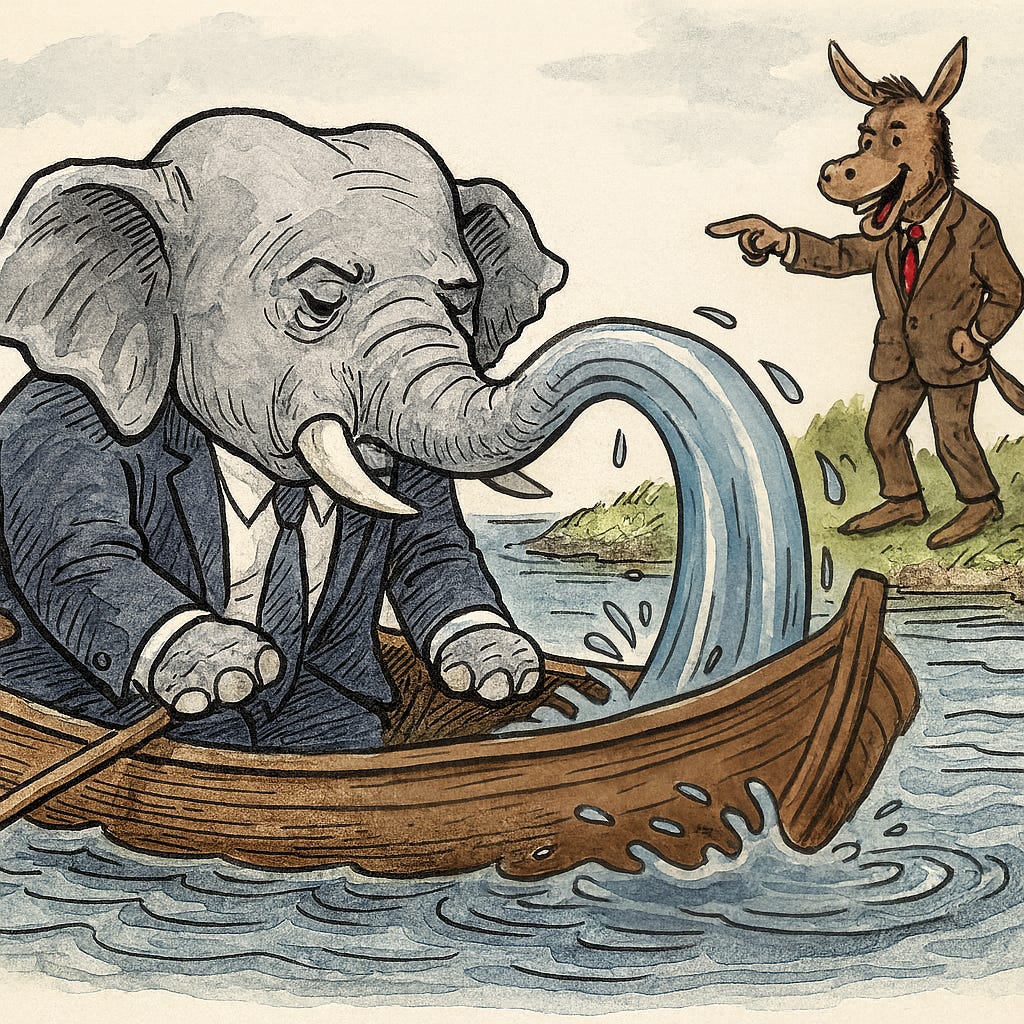
Stop Poking Holes in Your Own Boat
The hard truth is that the path forward for Oregon Republicans is not undermining the state’s election system with an end-vote-by-mail measure. It’s not a recall of Governor Tina Kotek that would just install Tobias Read as her successor. Both wastes time, drains resources, and convinces swing voters we’re more interested in complaining than competing.
Instead:
Target NAVs—especially those who share our values but sit out primaries.
Show them the practical reality: without party registration, their voice is muted where it matters most.
Build a coalition broad enough to win, then govern effectively.
Keep attacking the system, your own party members, and wasting your volunteers time and you’ll shrink your base and your ballot access.
Grow the party—don’t burn it down.
Ronald Reagan said it best: “The person who agrees with you 80% of the time is a friend and an ally—not a 20% traitor.”
Between now and next May, we have one mission that matters more than any recall effort, protest petition, or doomed end-vote-by-mail crusade: grow Oregon Republican voter registration rolls. Ask your county party leadership—demand it if you must—to focus every ounce of grassroots energy on registering new Republicans, especially from the massive pool of NAV voters who currently have no voice in our primaries.
Stop bleeding resources into fights that don’t deliver November victories. Instead, back candidates who can unite a broad coalition and actually win statewide—even if you only agree with them 80% of the time. Reagan had it right: unity is the path to power. Let’s stop chasing purity tests and start chasing wins.
Here is the good news, the Democrats are imploding, they lack leadership, and it seems the only strategy they have is to blame Trump. The non affiliated voters are ready to pick a side, and the side that is winning is more attractive.
That’s my viewpoint. If you agree, share this, and comment below, or let me know where I missed the mark. Doing nothing will give us the same results as the past, and Oregon deserves better.
I read your recent Substack piece with a mix of admiration and discomfort—the kind that signals something true is pressing against my long-held resistance. You made a compelling case, and I want you to know that I’ve decided to change my party affiliation to Republican, in part because of your argument.
This isn’t a conversion. It’s a concession.
I’ve long identified as an Independent—not out of indecision, but out of principle. I’ve resisted affiliation the way one might resist a label that oversimplifies a complex identity. For me, independence has been a way to honor nuance, to avoid tribal reflexes, and to vote with discernment rather than allegiance.
But your column laid bare a reality I can no longer ignore: that by remaining unaffiliated, I’ve been sidelining myself from the most consequential stage of candidate selection. It’s not voter suppression—it’s self-suppression. And while I still bristle at the machinery of party politics, I recognize that influence requires entry, not just observation.
I struggled with this decision. I’m ill-tempered by nature toward affiliation. I value ambiguity, paradox, and the freedom to dissent. I worry that by registering with a party, I’m surrendering some of that freedom—or at least appearing to.
I’m also aware that today’s candidates increasingly shape their messaging to appeal to independents like me—our numbers and unpredictability make us a force they can’t afford to ignore. But shaping messaging isn’t the same as shaping outcomes, and I’ve come to see that participation in primaries is essential if I want my voice to matter before the general election stage.
So I’m stepping in—not to pledge loyalty, but to participate meaningfully. I’ll vote in the primaries. I’ll help shape the field. And I’ll continue to question, challenge, and think independently, even from within the tent.
Thanks for the nudge. It was well-aimed.
The job of all politicians and political parties is to advance win elections and advance policy positions. Achieving both of those goals requires coalition building by advancing ideas that can at least win 50% +1 votes. Convincing voters to pre-align with a party makes getting to that threshold easier.
However it happens getting a majority to align with a candidate or policy means presenting positions that a majority feels sufficiently represents them or at the very least doesn't repel them. Oregon Republicans have clearly failed to accomplish this political neccesity, which shows that it would be advisable to resolve that problem. Absent whatever reforms are necessary it seems like a tough road to travel.