End Vote-by-Mail? Fine.
Now Explain Who Counts the Ballots.

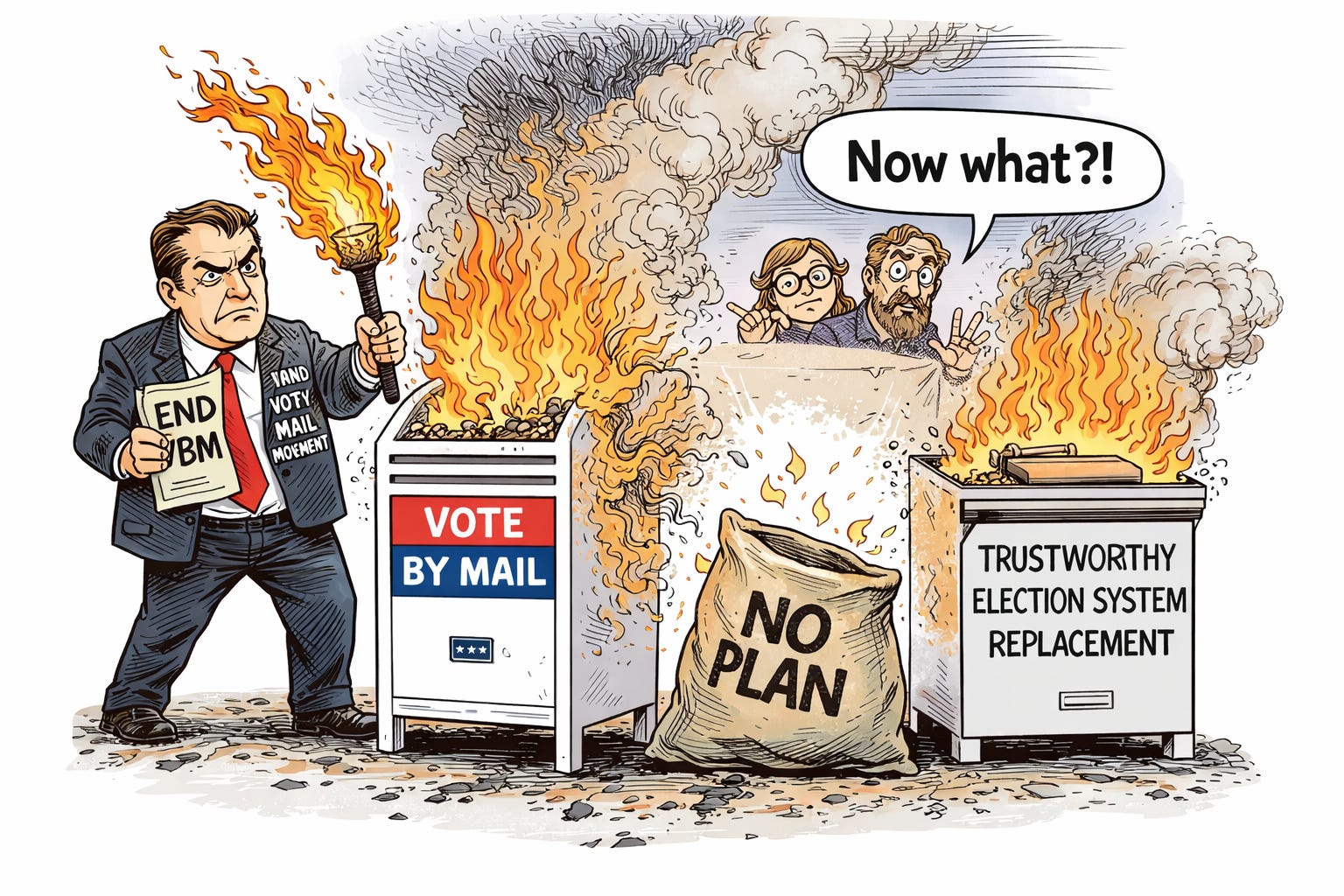
Oregon has a voter apathy problem. Not a mystery. Not a conspiracy. A reality.
Multnomah County alone has more than half a million registered voters, and like it or not, it drives statewide outcomes. That fact has pushed many Oregonians outside Portland into resignation. Some joke darkly that the state is “run by Portland.” Others stop joking and start packing maps for Idaho under the banner of Greater Idaho. When people feel politically irrelevant, apathy isn’t a moral failure, it’s a rational response.
Into that frustration marches the #ENDVBM movement, waving flags, chanting about “patriotic Election Day voting,” and promising to tear down Oregon’s vote-by-mail system in favor of single-day, in-person, hand-counted elections.
I get the sentiment. I share part of it.
There is something fundamentally civic and sacred about taking time out of your life to show up on Election Day, present ID, cast a paper ballot, and participate openly in self-government. Many Americans grew up with that ritual. It mattered. It still matters.
But sentiment is not a system.
And nostalgia is not an election plan.
The Inconvenient Question the ENDVBM Crowd Won’t Answer
Let’s pretend, just for a moment, that polling is wrong. That political gravity fails. That somehow, against all odds, a citizens’ initiative succeeds and Oregon ends vote-by-mail.
Now what?
Who exactly is going to run elections in Multnomah County?
Who staffs the polling places?
Who recruits precinct volunteers?
Who verifies voter rolls?
Who oversees chain-of-custody?
Who counts tens of thousands of ballots, precinct by precinct, under public scrutiny?
Because here’s the uncomfortable truth: Republicans currently have almost no ground game in Multnomah County.
Not opinions. Not vibes. Receipts.
In many Portland precincts with 5,000 to 9,000 registered voters, there are zero Republican Precinct Committee Persons. Zero. No bench. No volunteer infrastructure. No trained observers. No trusted local teams.
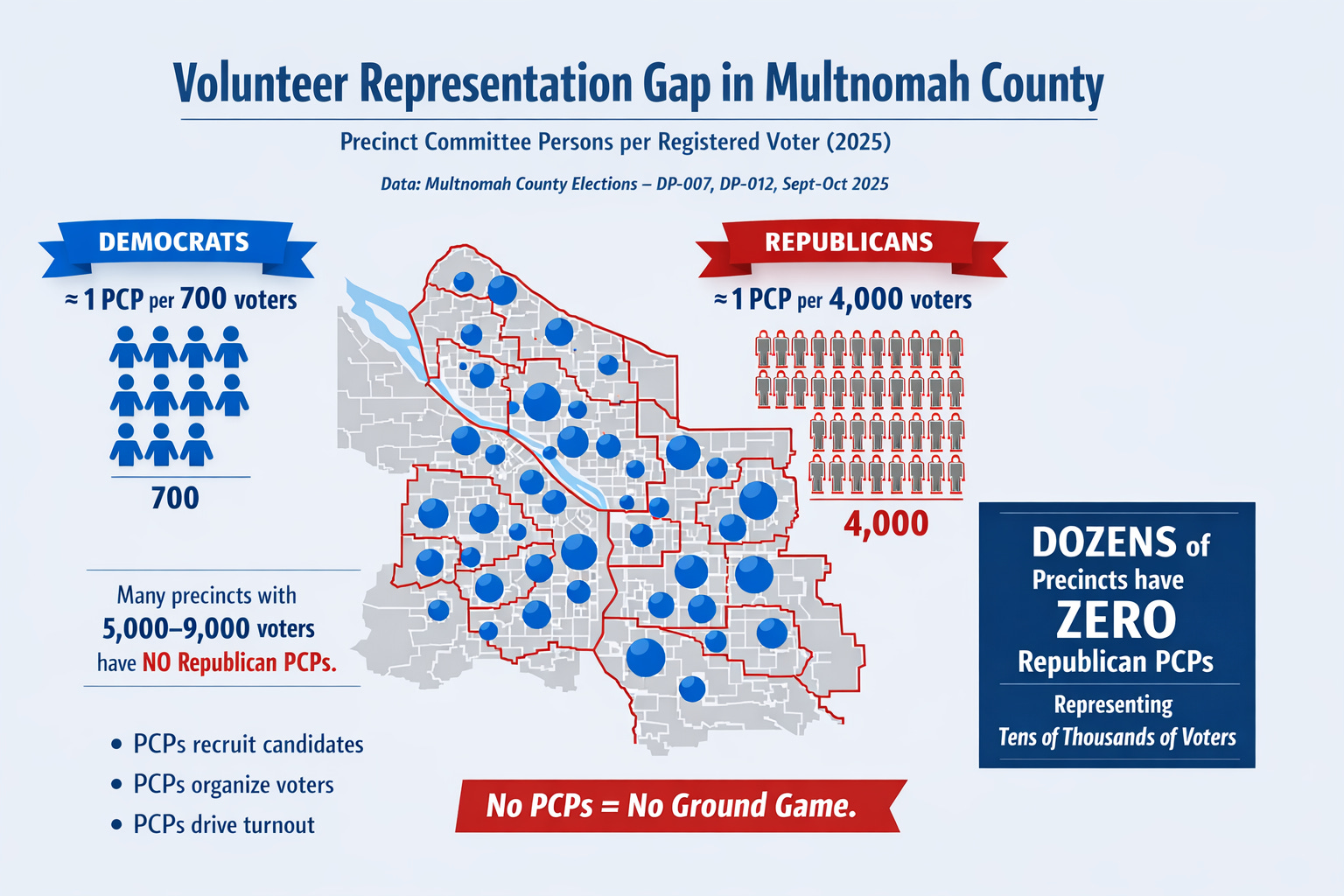
So ask yourself… honestly… if vote-by-mail disappeared tomorrow, would Republicans trust the results coming out of Portland?
And if the answer is “no,” then the next question is unavoidable:
What system replaces it that anyone could trust?
You Can’t Hand-Count Ballots With Facebook Posts
Ending vote-by-mail doesn’t magically create volunteers.
It doesn’t conjure election workers.
It doesn’t produce trained precinct officials out of thin air.
Hand-counting ballots requires people. Lots of them. Calm, trained, local people willing to spend 12-hour days inside schools, churches, and community centers, under pressure, with observers watching every move.
Right now, conservatives barely have enough volunteers to staff a booth at a county fair, let alone oversee election operations in the most politically hostile city in the state.
That’s not an insult. It’s an operational reality.
Patriotism Isn’t Enough
Some in the ENDVBM movement talk as if patriotism alone solves logistics.
It doesn’t.
I believe deeply in civic duty. I believe voting should be taken seriously. I believe paper ballots matter. I believe election integrity matters.
But integrity is built, not declared.
And tearing down a system without a credible replacement doesn’t strengthen trust, it obliterates it.
If Oregon ended vote-by-mail tomorrow, we wouldn’t get a cleaner election. We’d get chaos, litigation, long lines, uneven enforcement, volunteer shortages, and deep mistrust, especially in urban counties where one side lacks representation entirely.
That isn’t reclaiming democracy. That’s lighting it on fire and hoping the smoke clears in your favor.
The Hard Truth
Oregon’s election system didn’t fail because people stopped showing up to polling places.
It evolved because people stopped staffing them.
Vote-by-mail filled a vacuum created by apathy, mobility, and modern life. You can argue about whether that evolution was good or bad, but pretending you can reverse it overnight without rebuilding the civic infrastructure first is fantasy.
Real reform starts with ground game, not grandstanding.
With local volunteers, not viral hashtags.
With representation inside the system, not shouting at it from outside.
Until conservatives are willing to do the unglamorous work, precinct by precinct, neighborhood by neighborhood, ending vote-by-mail isn’t a reform plan.
It’s a protest.
And protests don’t count ballots.
That’s my viewpoint. It’s free, so consider share it.
First time reader? Subscribe, it’s free.
Appreciate the sentiment, consider a small donation, buy me a coffee, I was up at 4AM writing this today, and boy do I need another cup!
Sources & Data (Do Your Own Research)
• Multnomah County – Registered Voters by Precinct (DP-007)
Total registered voters in each precinct (all parties)
https://multco.us/file/_precinct_voter_count_updated_-_10/02/2025.pdf/download
• Multnomah County – Democratic Precinct Committee Persons (DP-012)
Elected and appointed Democratic PCPs by precinct
https://multco.us/file/precinct_committeeperson_report_-_democratic_party_-_updated_9-30-2025.pdf/download
• Multnomah County – Republican Precinct Committee Persons (DP-012)
Elected and appointed Republican PCPs by precinct
https://multco.us/file/precinct_committeeperson_report_-_republican_party_-_updated_9-30-2025.pdf/download
• Methodology Note
PCP-to-voter ratios calculated using elected PCPs only, divided by total registered voters per precinct (all parties included).
Strong argument here. The precinct committee vacancy data realy exposes the operational gap that gets ignored in reform rhetoric. I ran a rural voter turnout project back in 2019 and we couldn't even find enough volunteers to staff a single-day canvasing operation, let alone year-round election infrastructure. Dismantling a working system before buliding its replacement is how you get worse outcomes, not better. The trust issue cuts both ways but at least vote-by-mail has audit trails.
Thank you Natalia, I have not heard of any "Party" unofficial vetting process. Meetings are required to be open to all elected PCP's and party organization is grass roots and even protected by Oregon law:
A person must be registered in Oregon as a member of a major political party (e.g., Republican or Democratic).
OregonLaws
The candidate must have been a registered member of that party for at least 180 days before the filing deadline for the candidacy declaration.
Oregon Secretary of State
Must have an active voter registration in Oregon.
Apart from the above 3 legal qualifications, a county party cold reorganize with a caucus of newly elected PCP's with whatever changes they feel need to be made to the county bylaws, and organization structure.
Where you are correct, is internal faction fractioning is real. Our founding father warned against factions, and in the ORP we have factions within factions causing fracture and infighting. The now shorter ORP platform is an opportunity to find common ground on broader 80% issues and unify, but will that happen. It's really up to the minority stop sicking on issues that are not more broadly supported, and unify behind issues that have wide support across oregon. We did this on the NoTaxOregon referendum. Join the Oregon Freedom Coalition and make a difference.